Disclosure: As an Amazon Associate, Varnilo earns from qualifying purchases at no extra cost to you. Our guides are built on deep manufacturer specification analysis, collector forum consensus, and verified owner reports.
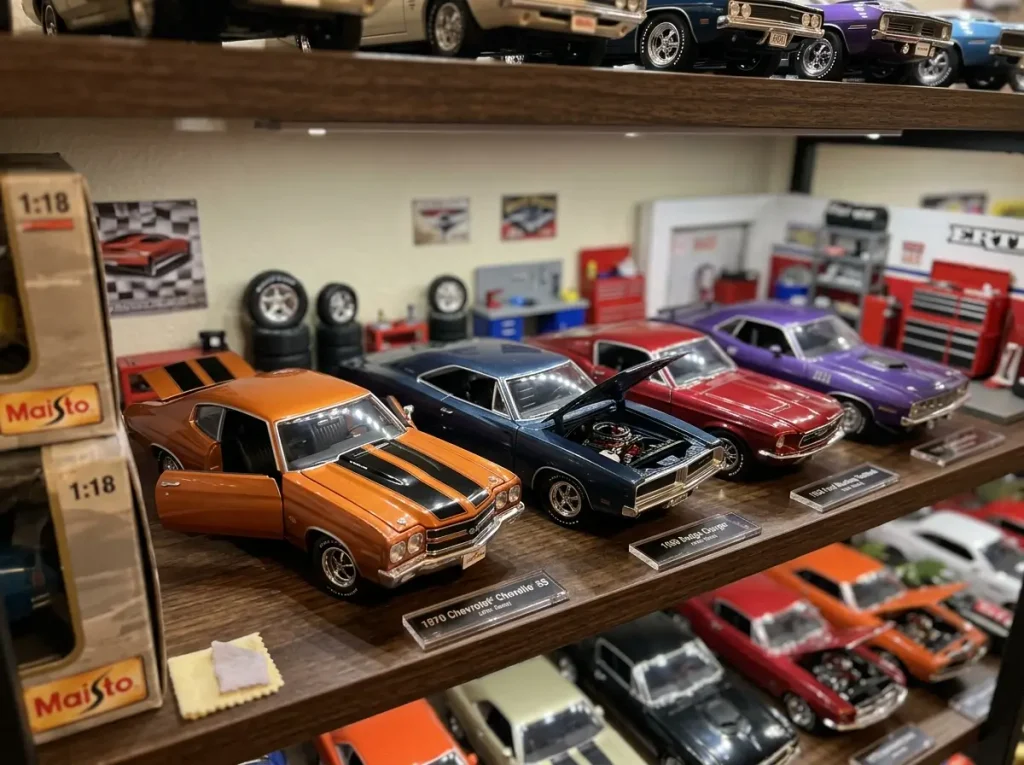
For collectors of American automotive history, few shelf centerpieces command attention quite like premium 1:18 diecast muscle cars. In the 1:18 scale segment, the true differentiator between a generic mass-market toy and an authentic collector masterpiece lies beneath the front sheet metal. When you pop the miniature hood pins or release the scale latch, you want to see braided fuel lines, authentic distributor routing, miniature battery cables, and accurate carburetor linkages—not a single flat slab of molded black plastic.
To identify the absolute finest scale replicas available today, we conducted an exhaustive investigation across manufacturer engineering sheets, checked physical part breakdowns, and analyzed hundreds of threads across premier collector venues like the DiecastXchange community and the enthusiast discussions on r/Diecast. We cross-referenced these scale-hobbyist insights with verified owner reports on Amazon to evaluate paint consistency, structural zinc alloy integrity, and mechanical hinge durability. Below are the definitive high-detail muscle cars worthy of pride of place in your display cabinet.
Auto World 1971 Plymouth HEMI Cuda 1:18 Scale
Praised across scale forums for delivering near-precision tier engine plumbing at a reasonable collector price point. It features the legendary 426 HEMI V8 complete with separate fuel lines, factory-accurate dual four-barrel carburetors, realistic hood hinge geometry, and an authentic shaker hood setup resting atop a heavyweight diecast chassis.
Comparing the Top 1:18 Diecast Muscle Cars
| Model | Key Specs & Materials | Community Verdict | Amazon Listing |
|---|---|---|---|
| Auto World 1971 Plymouth HEMI Cuda | ZAMAK zinc diecast body, wired 426 HEMI, scissor-style metal hood hinges, steerable front wheels, rotating driveshaft. | Widely considered the sweet spot for engine bay wiring and factory-correct underhood decals without paying artisan resin prices. | Check Price → |
| ACME 1970 Pontiac GTO Judge | Heavy-gauge diecast, Ram Air IV 400 V8, individual spark plug leads, functional suspension, opening doors/trunk/hood. | Celebrated among forum builders for ultra-thin panel gaps and true-to-scale hood springs rather than crude plastic doglegs. | Check Price → |
| GMP 1969 Chevrolet Camaro Z/28 | Museum-grade multi-piece casting, DZ 302 small block, braided fuel lines, photo-etched throttle linkage, opening cowl hood. | The gold standard for mechanical accuracy. Praised on enthusiast forums for intricate engine block detailing and metal fittings. | Check Price → |
In-Depth Analysis: The Best 1:18 Scale Muscle Cars Under the Hood
1. Auto World 1971 Plymouth HEMI Cuda 1:18 Scale
Auto World’s American Muscle tooling line has long served as a backbone for diecast enthusiasts who insist on authentic engine bays without entering four-figure brass collection territory. Measuring roughly 10.5 inches in length, this 1971 HEMI Cuda replica captures the aggressive stance of Chrysler’s E-body platform with substantial metal heft.
Lift the iconic Shaker hood, and the model reveals its standout feature: a fully plumbed 426 cubic-inch Elephant motor. Rather than molding the distributor and wires directly into the cylinder head casting, Auto World utilizes flexible rubberized ignition leads routed cleanly from the distributor cap into each spark plug well. Enthusiasts on collector build threads frequently praise the inclusion of accurate Chrysler corporate blue engine paint, miniature radiator overflow tubes, and crisp Mopar battery decals. The hood functions via realistic scissor hinges rather than out-of-scale dogleg hinges, allowing the hood to sit flush against the fenders when closed.
- Independent spark plug wiring and authentic Mopar decal applications underhood.
- Scale scissor-style hood hinges that preserve realistic exterior shut lines.
- Working driveshaft linked directly to the rear differential and rear wheels.
- Interior carpeting uses textured molding rather than genuine electrostatic flocking.
- Delicate shaker scoop requires gentle handling when opening the hood to prevent snapping the locating tabs.
2. ACME 1970 Pontiac GTO Judge 1:18 Scale
ACME Diecast (derived from the historic Lane Exact Detail and GMP lineages) specializes in high-fidelity muscle cars with intricate mechanical subsystems. Their 1970 Pontiac GTO Judge is considered by scale collectors as one of the most authentic representations of GM’s A-body platform ever cast in zinc alloy.
Beneath the twin-scoop Ram Air hood sits an astonishingly accurate Pontiac 400 (or optional 455 HO) V8. ACME engineers went beyond basic wiring: this engine bay features genuine miniature metal springs supporting the hood hinges, separate fuel filters, flexible heater core hoses, brake booster vacuum lines, and a meticulously painted Rochester Quadrajet carburetor. Forum members consistently highlight that ACME models feature individual photo-etched metal badging instead of cheap printed tampo decals. The front steering mechanism connects through working linkages, while the undercarriage boasts working coil-over suspension components.
- Functional miniature metal tension springs on the opening hood hinges.
- Complete plumbing suite including vacuum lines, heater hoses, and individual spark wires.
- Fully carpeted interior floorboard with textured bucket seats and fabric seatbelts.
- Hood hinges are finely tensioned and must not be forced beyond their natural 60-degree stop point.
- Higher weight profile demands sturdy display shelving to prevent tire flat-spotting over years.
3. GMP 1969 Chevrolet Camaro Z/28 1:18 Scale
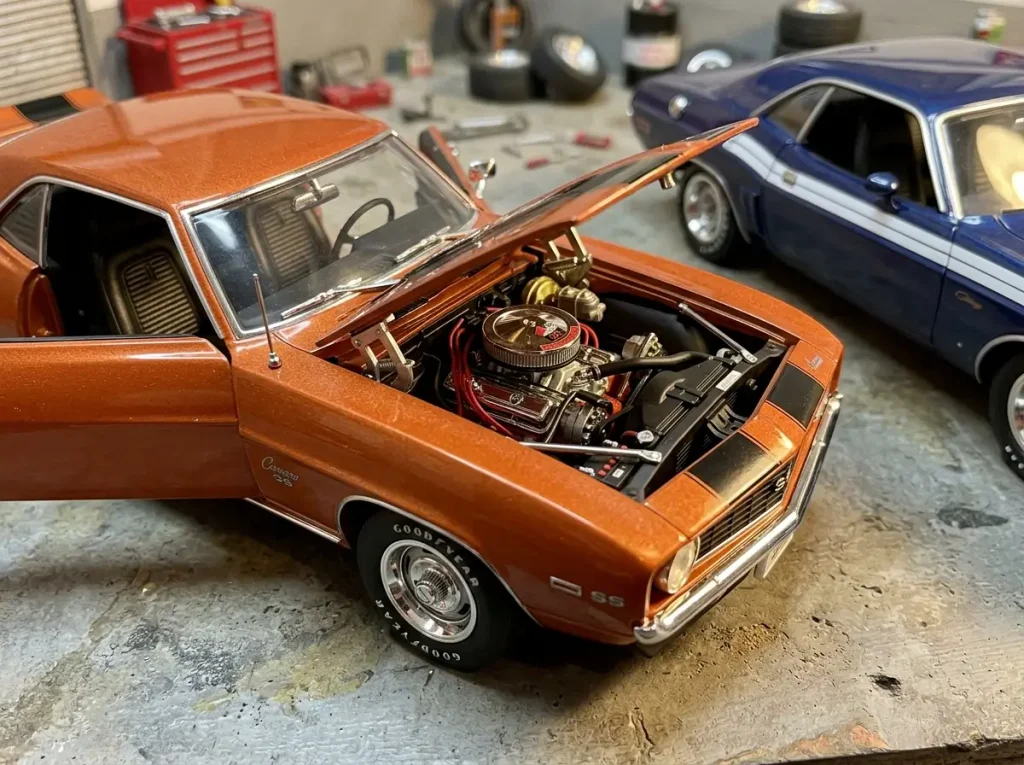
For collectors seeking museum-grade execution, GMP models represent the mechanical apex of high-volume diecast production. Their 1969 Camaro Z/28 is revered on scale car communities like r/Diecast for pushing miniature engineering tolerances to the extreme.
Pop the cowl-induction hood, and you are greeted by a DZ 302 cubic-inch small-block V8 rendered with genuine multi-piece precision. Unlike standard models where engine blocks are two halves glued together, GMP utilizes separately molded cylinder heads, intake manifolds, ribbed valve covers, and photo-etched metal throttle return springs. Real braided stainless-steel-style fuel lines connect to the fuel pump and dual Holley carburetors on cross-ram variants. The engine bay firewalls feature correct factory stampings, windshield washer reservoirs with visible fluid lines, and a scale Delco battery with individual positive and negative terminal clamps.
- Unrivaled engine bay detail featuring braided lines, throttle springs, and battery clamps.
- Exquisitely engineered scissor hood mechanisms that recreate 1:1 scale opening motion.
- Removable air cleaners on select variants allowing unobstructed views of carburetor throats.
- Premium price point reflects the high part count and hand-assembly process.
- Microscopic photo-etched metal parts are fragile; dusting requires a fine camel-hair brush.
Collector Guide: What Defines a Truly Detailed Diecast Engine Bay?
When searching for premium 1:18 diecast muscle cars, casual buyers often judge a model solely by exterior paint shine. However, experienced collectors inspect the engine compartment first. Here are the specific engineering indicators that separate high-end precision models from budget shelf-fillers:
1. Hinge Architecture: Scissor Hinges vs. “Doglegs”
On budget diecast cars (typically under $50), manufacturers use massive curved plastic or metal brackets known in the hobby as “dogleg hinges.” When opened, these brackets penetrate directly into the engine compartment, destroying scale realism and crowding the firewall. Premium manufacturers like Auto World, ACME, and GMP engineer miniature multi-link scissor hinges or photo-etched arms with scale tension springs. This engineering feat allows the hood to open realistically while keeping the inner fender wells completely clean and historically accurate.
2. Independent Wiring vs. Molded-in Relief
Examine the ignition system. Low-tier diecasts mold the spark plug wires directly into the black plastic engine block, painting them with a quick brush stroke of silver or red. On precision-tier models, the engine block, intake manifold, valve covers, and distributor are cast as independent pieces. Eight individual flexible wires originate from the distributor cap and insert cleanly into pre-drilled cylinder heads. Premium models also incorporate flexible rubber radiator hoses with miniature metallic hose clamps and clear fuel lines.
3. Engine Block Materials and Finishes
Look at the engine block finish. Factory muscle cars left Detroit with distinct corporate paints: Chevy Orange, Pontiac Metallic Blue, Ford Corporate Blue, or Mopar Street HEMI Orange. Precision models accurately duplicate these gloss levels rather than using generic unpainted plastic. Furthermore, premium collectors look for painted intake manifolds (matching aluminum or cast iron textures), separate chrome air cleaner housings with authentic paper-filter texture rings, and factory-accurate warning labels on radiator cowls and battery tops.
Frequently Asked Questions
How can I safely open the detailed hood without snapping delicate hinges?
Never pry open a diecast hood using your fingernails directly against the paint, as this can chip clear coats or bend delicate photo-etched scissor hinges. Use an acrylic or silicone-tipped collector probe (often included with GMP and ACME models) to gently catch the under-edge of the hood near the cowl, raising it smoothly along its intended pivot geometry.
Why are opening diecast models generally preferred over sealed resin models?
While sealed resin models often boast razor-sharp panel lines, they completely eliminate the tactile joy of exploring mechanical components. For muscle car collectors, the engine is the soul of the vehicle; having an opening hood with wired V8 powerplants provides unmatched display versatility and appreciation for 1960s and 70s engineering.
How do I clean dust out of an intricate 1:18 scale engine bay?
Never use canned compressed air directly on detailed engine bays; the intense velocity can snap delicate spark plug wires or dislodge miniature carburetors. Instead, use a soft camel-hair makeup brush or specialized hobby model brush while holding a low-power handheld vacuum cleaner a few inches away to capture airborne particles.
Do detailed diecast muscle cars retain their value over time?
Limited-edition diecasts from ACME, GMP, and premium Auto World runs often maintain or increase in collector value, especially when kept in climate-controlled environments with original factory packaging. Toolings with historically correct engine wiring and opening features consistently command higher aftermarket demand than generic sealed replicas.
Ready to upgrade your scale garage with authentic American horsepower? Explore the top-rated 1:18 scale diecast muscle cars with opening hoods on Amazon to find the perfect centerpiece for your collection.