Disclosure: As an Amazon Associate, Varnilo earns from qualifying purchases at no extra cost to you. Our guides are built on deep manufacturer specification analysis, collector forum consensus, and verified owner reports.
Scrubbing calcified soap scum, hard water buildup, and deeply ingrained mildew from bathroom grout is widely considered one of the most physically exhausting maintenance chores in any home. Investing in a high-quality electric spin scrubber promises to replace tedious elbow grease with mechanized torque. However, the market is flooded with dozens of generic, re-badged units that look identical on digital storefronts but suffer from catastrophic motor stall under moderate hand pressure, brittle plastic extension collars, and non-replaceable lithium batteries that die after six months of sporadic use.
Rather than relying on superficial marketing claims, our evaluation methodology analyzes engineering blueprints, motor stall-torque figures, ingress protection ratings (IPX), and long-term user reports. We synthesized owner experiences shared across home-care communities such as the Reddit r/CleaningTips community and the practical longevity discussions found on r/BuyItForLife. By cross-referencing factory teardowns with verified owner feedback, we isolated the top-performing motorized scrubbers capable of revitalizing dirty ceramic tiles, porous grout lines, and fiberglass showers without premature motor burnouts.
Ryobi ONE+ 18V Cordless Compact Power Scrubber (P4510)
Unlike disposable consumer scrubbers with permanently sealed, non-serviceable battery packs, the Ryobi ONE+ Compact Scrubber runs on standard Ryobi 18V power tool batteries. Combining an IPX7 fully submersible washhead, 210 RPM of sustained high-torque rotation that resists stalling even under heavy manual leaning, and an ecosystem of interchangeable hard-bristle brushes, this tool represents the pinnacle of long-term repairability and raw grime-stripping power.
| Model | Key Specs & Materials | Community Verdict | Amazon Listing |
|---|---|---|---|
| Ryobi ONE+ 18V (P4510) | 210 RPM; IPX7 submersible head; Swappable 18V ONE+ battery; Heavy-duty glass-filled nylon body. | Universally acclaimed by DIYers for industrial torque and zero battery decay risk due to swappable packs. | Check Price → |
| Dremel Versa PC10-01 | 2,200 RPM high-speed rotary motor; 4V internal Li-Ion; Splash guard enclosure; Hook-and-loop pad system. | Praised for spot-treating heavily stained grout lines; requires gentle pressure to prevent speed drop. | Check Price → |
| Labigo Electric Scrubber LA1 Pro | Dual speed (300/400 RPM); Telescopic aluminum shaft (up to 47.6″); 2,500mAh internal battery; 4 brush heads. | Favorite ergonomic pick for homeowners with back/knee issues cleaning high tile walls and bathtubs. | Check Price → |
Detailed Technical Evaluations of the Top Three Scrubbers
1. Ryobi ONE+ 18V Cordless Compact Power Scrubber (Model P4510)
The Ryobi P4510 fundamentally rethinks what an electric spin scrubber should be by divorcing the motorized scrubbing head from disposable consumer electronics standards. Constructed with glass-filled nylon housing identical to professional workshop power tools, the P4510 uses a dedicated planetary gear system calibrated to maintain roughly 210 RPM. While 210 RPM sounds moderate compared to handheld rotary tools, the low gear ratio provides staggering stall resistance: you can put your full body weight into a grout trench without the motor grinding to a halt.
On enthusiast platforms like Reddit’s home improvement forums, the Ryobi P4510 is frequently cited as the only scrubber that survives commercial-level chemical exposure. The unit features an IPX7 waterproof rating up to three feet deep for 30 minutes, meaning you can submerge the head into standing soapy water without short-circuiting the drive motor. Its standard 1/4-inch hex connector and triangular drive hub accommodate both proprietary Ryobi bristled attachments and standard aftermarket nylon bristle cups.
- High-torque reduction gearing resists motor stalling under extreme manual pressure.
- Removable 18V ONE+ battery platform completely eliminates planned obsolescence.
- True IPX7 waterproof housing allows total submersion during tub cleaning.
- Noticeably heavier (approx. 2.7 lbs with battery) than consumer stick scrubbers.
- Sold as a bare tool or with battery kit; significantly costlier upfront if you don’t already own ONE+ chargers.
2. Dremel Versa PC10-01 High-Speed Power Cleaner
The Dremel Versa approaches tile and grout scrubbing from the opposite philosophical perspective: high velocity rather than massive torque. Leveraging Dremel’s century-long dominance in micro-rotary mechanics, the Versa spins at an astonishing 2,200 RPM powered by an integrated 4V max lithium-ion cell. This speed profile works through kinetic friction rather than abrasive brute force. When paired with specialized eraser or scouring pads, it pulverizes superficial grout mildew and baked-on shower glass calcium in seconds.
Verified purchasers frequently note that technique is critical with the Versa. If an operator leans heavily against the tool, the electronic current limiter engages to protect the motor from burning out, immediately throttling speed. Instead, the tool is engineered to glide across ceramic surfaces lightly, letting the high RPMs perform the aggregate removal. The unit includes a rubberized retractable splash guard that prevents detergent and dirty wastewater from splattering across dry bathroom walls during high-speed spinning.
- Exceptional 2,200 RPM rotation speeds drastically reduce dwell time on mineral stains.
- Ultra-compact, palm-grip form factor allows pinpoint accuracy inside tight shower niches.
- Flexible hook-and-loop backing pad supports standard scouring, non-scratch, and micro-fiber accessories.
- Internal 4V battery yields roughly 15 to 25 minutes of continuous runtime before requiring micro-USB recharge.
- Electronic stall sensor triggers easily if excessive downward force is applied.
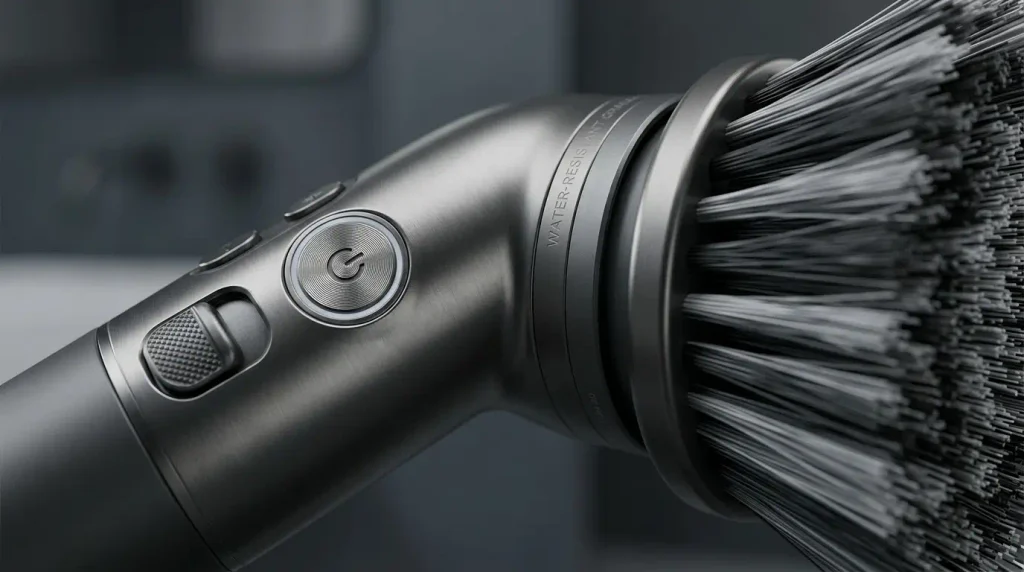
3. Labigo Electric Spin Scrubber LA1 Pro
For large-format tile floors, continuous floor-to-ceiling bathroom surrounds, and standard porcelain bathtubs, bending down with a compact handheld tool causes significant lumbar fatigue. The Labigo LA1 Pro directly addresses ergonomic strain with an extendable stainless-steel and aluminum shaft that adjusts from 24 inches up to 47.6 inches. This lets users stand upright while scouring floor tile grout or reach the top corner of a 9-foot shower ceiling without standing on step ladders.
Internally, the LA1 Pro features a dual-speed electric planetary motor offering 300 RPM for delicate porcelain surfaces and 400 RPM for stubborn, discolored grout lines. Community feedback across cleaning forums highlights the utility of its included corner-crevice brush, which tapers to a 45-degree angle precisely sized to clean inside 90-degree tile intersections. The 2,500mAh internal battery provides an impressive real-world runtime of roughly 70 to 90 minutes on a single USB-C charge, sufficient for multiple full-bathroom deep cleanings.
- Adjustable 47.6-inch extension arm completely eliminates crouching and knee strain.
- Generous 2,500mAh battery pack delivers up to 90 minutes of continuous runtime.
- Includes specialized triangular and dome nylon brushes designed specifically for architectural tile joints.
- Long extension lever creates flexing at the connection collars when high manual pressure is exerted.
- The handle housing is splash-proof (IPX4) rather than fully submersible, requiring careful rinsing.
Tile & Grout Engineering: How to Select the Right Electric Scrubber
Grout is fundamentally different from smooth ceramic or porcelain glazing. As a cementitious, porous mixture of sand and bonding agents, grout absorbs minerals, bodily oils, and mold spores deep beneath its surface layer. Cleaning it mechanically requires balancing three distinct engineering dynamics:
1. Low-Speed Torque vs. High-Speed Abrasion
Many shoppers mistakenly assume higher RPM is inherently superior. In reality, a scrubber operating at 2,000+ RPM without sufficient torque will bog down and stall the moment the nylon bristles enter a recessed grout channel. Low-to-moderate RPM units (200 to 450 RPM) backed by high-torque internal gear reductions are far more effective at dislodging heavy particulate dirt because they maintain rotation under physical load. Conversely, high-speed scrubbers excel at polishing surface-level soap film and scale when paired with dense non-scratch scouring pads.
2. Bristle Tensile Strength and Tip Geometry
The brush head material dictates how much mechanical force transfers into the grout matrix. Standard consumer units utilize broad, flat polypropylene bristle wheels that span across both the tile and the grout line simultaneously. Because tile sits higher than the recessed grout line, flat brushes ride along the tile surface, barely touching the lower grout canal. For grout lines, ensure your chosen tool supports cone-shaped, pointed nylon brushes or dedicated grout narrow-strip brushes that channel all rotational energy directly into the grout recess.
3. Waterproofing Ratings: IPX4 vs. IPX7
Water intrusion is the single leading cause of premature failure in electric cleaning gadgets. Always verify the Ingress Protection (IP) rating. An IPX4 rating indicates basic splash resistance; you can safely spray the brush head, but water entering through the charging port or handle switches will corrode the motherboards. An IPX7 rating (found on professional models like Ryobi) ensures that the motor housing can withstand complete submersion in up to one meter of soapy water, making it immune to accidental drops into a filled bathtub.
Frequently Asked Questions
Will an electric spin scrubber damage unsealed tile or colored grout?
Hard nylon bristles combined with aggressive motorized rotation can slowly abrade softer materials like unsealed natural limestone, marble, or crumbling vintage grout. For natural stone and colored sanded grout, use soft-to-medium bristles and avoid acidic cleaning agents. Always test an inconspicuous corner to verify that the rotation does not leave micro-scratches on glazed finishes.
Can I use bleach or caustic chemicals with motorized scrubbers?
Exercise caution when pairing high-speed scrubbers with concentrated bleach or harsh caustic solutions. Centrifugal force naturally flings liquid droplets off rotating brush bristles at high speeds, which can cause chemical splatter on drywall, bathroom mirrors, towels, or into your eyes. Always wear protective eyewear and consider using gel-based or foaming tile cleaners that adhere to the surface rather than thin liquid detergents.
Why do rechargeable spin scrubbers lose battery power so quickly?
Many consumer-grade scrubbers utilize low-cost lithium-ion cells without active battery management circuitry. If these devices are stored in humid bathroom cupboards or left on trickle chargers continuously, the cells suffer from accelerated chemical breakdown. For maximum lifespan, charge the device until full and store it in a dry, room-temperature environment, or choose a scrubber with swappable power-tool batteries like the Ryobi 18V platform.
How do I disinfect and clean the brush attachments after use?
After scrubbing mold or soap scum, detach the brush heads immediately. Soak the bristles in a mixture of warm water and mild disinfectant or diluted white vinegar for 15 minutes to eliminate remaining bacterial colonies. Allow the attachments to dry completely before storing them in an enclosed cabinet to prevent lingering mildew odors.
Ready to upgrade your cleaning kit? Explore the verified owner reviews, brush bundle accessories, and current promotions on Amazon to choose the ideal electric spin scrubber for tile and grout that matches your home layout.