Disclosure: As an Amazon Associate, Varnilo earns from qualifying purchases at no extra cost to you. Our guides are built on deep manufacturer specification analysis, collector forum consensus, and verified owner reports.
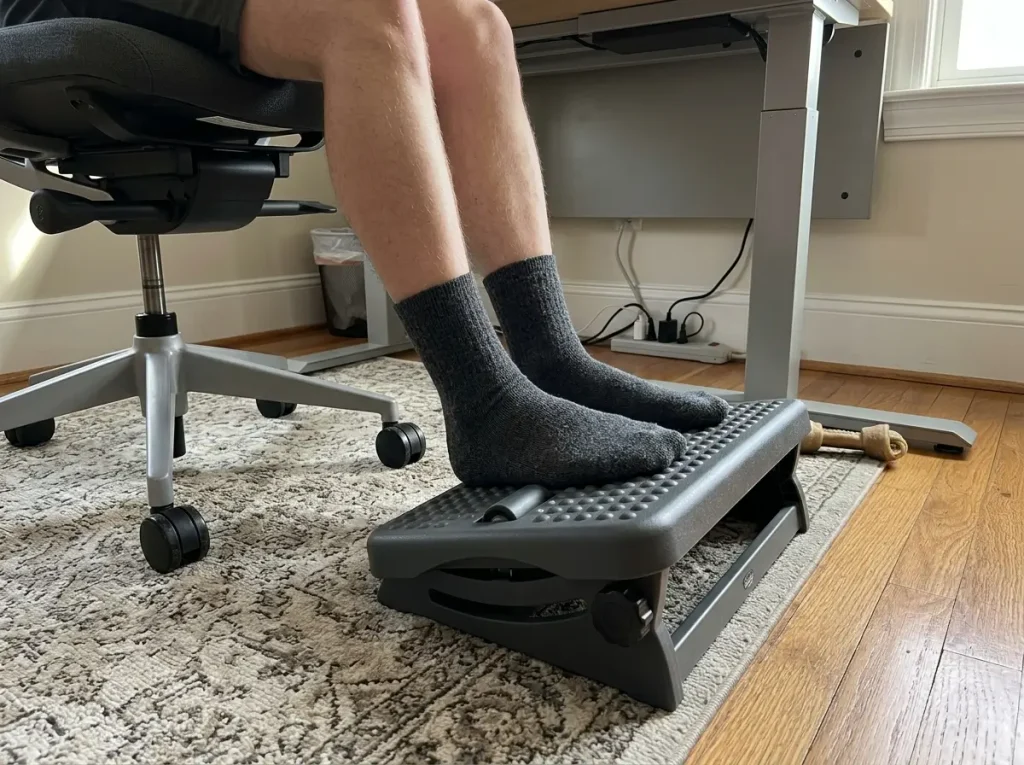
Sitting through marathon eight-to-ten-hour shifts in a home office frequently wrecks lumbar posture, limits circulation in the lower extremities, and causes severe thigh pressure points. Finding the right ergonomic footrests for remote workers is often the missing element in resolving stubborn lower back tension and restless leg habits. Rather than relying on simulated short-term trials, our guide synthesizes engineering spec sheets, mechanical load ratings, and long-term owner reviews sourced from enthusiast communities like r/BuyItForLife and ergonomic setup discussions across home office threads.
ErgoFoam Adjustable Under Desk Foot Rest
Engineered with high-density polyurethane foam and a modular dual-height riser system, the ErgoFoam footrest consistently earns top accolades from long-shift computer workers. It provides genuine firm pelvic support that resists sag over years of continuous use, balancing plantar relaxation with correct femur alignment.
Comparing the Top Ergonomic Footrests for Remote Workers
Below is a direct comparison of structural dimensions, core materials, and practical field reliability derived from engineering schematics and user forums.
| Model | Key Specs & Materials | Community Verdict | Amazon Listing |
|---|---|---|---|
| ErgoFoam Adjustable | 17.3″ x 11.5″ x 3.9″/5.9″, High-Density PU Foam, Breathable Mesh Cover | Gold standard for foam longevity; avoids bottoming out even for heavy individuals. | Check Price → |
| Kensington SoleMate Comfort | 21.5″ x 14″ x 3.5″-5″, Impact ABS Chassis, Memory Foam Mat, Foot-Pedal Angle Lock | Best dynamic mechanical adjustment; ideal for desks shared between different heights. | Check Price → |
| iRest Under-Desk Foot Hammock | 25.5″ x 7.8″ Canvas, Steel Clamps, High-Tension Poly Cordage | Outstanding for reclined lounging and deep knee flexion; requires sturdy solid-wood desk lip. | Check Price → |
In-Depth Architectural & Owner Consensus Analysis
1. ErgoFoam Adjustable Under Desk Foot Rest
The ErgoFoam unit represents the quintessential balance between tactile arch cushion and orthopedic support. Measuring 17.3 by 11.5 inches, its base teardrop profile provides an arched cradle that can either sit flat on its rubberized bead underside or be flipped over to serve as an active rocker. The modular riser piece attaches via robust industrial hook-and-loop fasteners, extending vertical clearance from 3.9 inches up to 5.9 inches.
Verified workspace communities on Reddit, specifically threads across r/GoodValue, frequently highlight ErgoFoam’s proprietary foam density. Unlike budget memory foam slabs that flatten to pancake thickness after thirty minutes of sustained contact, the high-density formulation used here distributes calcaneal pressure evenly while keeping your knees bent at precisely 90 to 100 degrees.
- High-density core resists structural compression over thousands of work hours.
- Reversible design facilitates passive static resting or dynamic micro-rocking.
- Removable double-stitched velvet or mesh cover is machine washable.
- Mesh exterior variant can cause slight fabric pilling when used with coarse outdoor work boots.
- Lightweight frame can drift backward on ultra-slick laminate flooring unless anchored.
2. Kensington SoleMate Comfort Foot Rest with SmartFit System
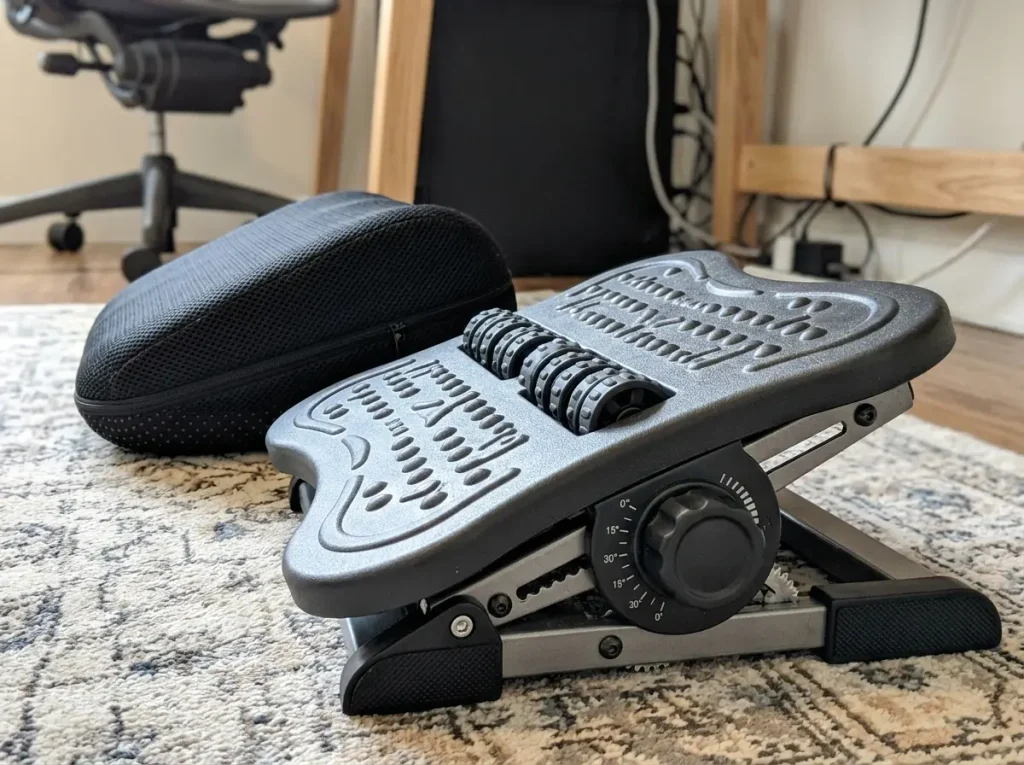
For workstation operators needing rigid mechanical articulation, the Kensington SoleMate Comfort is engineered around a heavy-duty copolymer base paired with a luxurious, non-allergenic memory foam overlay. The platform measures an expansive 21.5 by 14 inches, accommodating broad stances easily. What distinguishes the SoleMate is its patented foot-pedal lock system: users can tilt the footplate between 0 and 30 degrees and shift height from 3.5 to 5 inches without unseating themselves or fumbling beneath the desk.
Discussions among office ergonomics evaluators emphasize the utility of the Kensington SmartFit color-coding index. Long-term Amazon owner breakdowns indicate that users with chronic achilles tendon tightness or plantar fasciitis benefit heavily from the rigid, angled elevation, which takes constant tension off the gastrocnemius muscles.
- Hands-free foot pedal calibration lets you tilt the angle instantly.
- Generous platform width provides comfortable hip abduction during wide seating stances.
- Rugged structural base anchors firmly onto dense commercial carpets without slipping.
- Mechanical locking gears produce a distinct plastic click during adjustments.
- Memory foam pad is fixed to the tray and cannot be dropped into a washing machine.
3. iRest Under-Desk Foot Hammock
Taking a completely divergent approach to under-desk mechanics, the iRest Under-Desk Foot Hammock utilizes suspension physics rather than floor-mounted compressive resistance. Consisting of a reinforced, double-ply 25.5 by 7.8-inch cotton canvas sling suspended by high-tensile cords and rubber-padded steel universal clamps, this system hangs directly from the opposing edges of your desktop.
Community feedback across remote work forums details the distinct lifestyle niche this fills: it is purpose-built for workers who use deep-recline task chairs, sit-to-stand frames with crossbars, or those seeking variable limb elevation to reduce ankle edema. By adjusting the rope stopper clasps, you can swap between “work mode” (slight ankle cradle beneath the knees) and “leisure mode” (straight-leg horizontal suspension while reviewing documents).
- Zero floor footprint leaves under-desk space open for wire racks and computer towers.
- Suspended swing allows gentle foot swaying, which activates calf muscle pump mechanics.
- Non-marring silicone clamp feet safeguard solid oak, maple, and thick veneer finishes.
- Incompatible with glass tops, beveled chamfer edges, or desks lacking side overhangs.
- Provides zero static upward leverage for correcting pelvic tilt while typing upright.
Biomechanical Criteria: How to Select Your Foot Support
Selecting ergonomic equipment requires a clear audit of your biomechanics, chair geometry, and desktop dimensions. When choosing between hammocks, foam cushions, or articulated boards, balance these technical parameters:
1. Seat Pan Depth and Popliteal Clearance
The primary medical objective of an ergonomic foot support is removing concentrated mechanical load from your popliteal surface—the delicate nerve-rich zone behind your knees. If your ergonomic office chair cannot be lowered far enough to let your heels rest solidly on the floor without slumping your lower lumbar, an elevated platform like the ErgoFoam restores an anatomically ideal 90-degree pelvic orientation.
2. Static Plantar Stability vs. Micro-Movement
Orthopedic specialists frequently point out the risks of prolonged static loading. If your job involves intense, precise mouse drafting or audio mixing, a firm footing like the Kensington platform prevents unforced pelvic sway. Conversely, if your tasks involve long reading sessions, the free pendulum motion of an under-desk hammock or an inverted curved foam cushion encourages passive joint mobility, helping maintain vascular venous return.
3. Desktop Edge Geometry & Structural Strength
Hammock systems demand careful structural consideration before purchase. Never install clamp-based hammocks onto hollow-core engineered honeycomb paper desks (such as entry-level IKEA desks), as clamping torque can puncture thin surface laminates. Verify you have at least 2 inches of side overhang and a solid desktop thickness between 0.6 and 1.8 inches before choosing a suspended model.
Frequently Asked Questions
Do ergonomic footrests genuinely reduce lower back pain?
Yes. When your feet dangle or rest on your toes, your pelvis rotates forward into an anterior pelvic tilt, putting undue torque on the L4-L5 lumbar vertebrae. Elevating your feet to support your thighs parallel to the ground relieves pressure across the lower spinal discs and reduces sciatic irritation.
What is the ideal elevation height for a desk footrest?
For most desks set at standard 29-to-30-inch heights, a footrest offering between 3.5 and 5.5 inches of elevation provides proper ergonomic alignment for people between 5’2″ and 5’10”. Taller individuals often require merely 2 to 3 inches of subtle ankle tilt rather than extreme lift.
Can I use an under-desk footrest with shoes or only socks?
Foam cushions protected by tear-resistant ballistic nylon or smooth mesh can easily withstand standard running shoes and casual loafers. However, if you plan to wear heavy outdoor work boots or spiked soles, opt for high-impact ABS plastic trays like the Kensington SoleMate to avoid ripping fabric covers.
Are foot hammocks safe for motor-driven standing desks?
Yes, provided your cables and hammock suspension clearance do not snag on under-desk wire raceways, power bricks, or motor housings during height adjustments. Always run your motorized desk through a slow vertical dry test while observing the hammock ropes to verify they clear the control boxes.
To browse more setup enhancements and ergonomic desk configurations, explore our in-depth workstation evaluations across the Varnilo home office archives.