Disclosure: As an Amazon Associate, Varnilo earns from qualifying purchases at no extra cost to you. Our guides are built on deep manufacturer specification analysis, collector forum consensus, and verified owner reports.
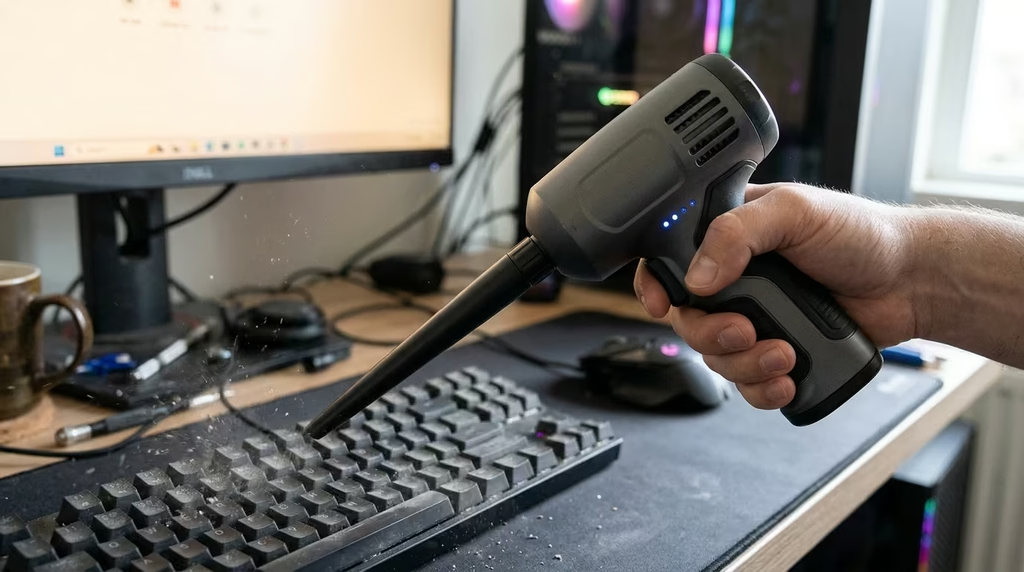
Anyone who has maintained a custom water-cooled rig or spent hours assembling a lubricated custom mechanical keyboard knows the sheer frustration of disposable canned air. Canned duster canisters drop pressure after five seconds of sustained spraying, release frozen propellant that risks thermal-shocking delicate surface-mount capacitors, and leave an oily bitterant film across keycaps. Investing in a high-grade cordless compressed air duster eliminates recurring expenses while delivering sustained, dry kinetic airflow designed to dislodge stubborn debris without moisture risks.
Whether you manage an intricate gaming battle station powered by a multi-device charging hub like a high-output GaN fast charging station or maintain sensitive peripheral hardware, finding an electric duster with the right balance of static pressure, brushless motor longevity, and fine-tip nozzle attachments is vital. Rather than relying on simulated marketing claims, we analyzed hundreds of verified owner teardowns, industrial motor schematics, and discussions across hardware communities like r/pcmasterrace to identify the top cordless blowers available today.
KiCA Jet Fan 2 Electric Compressed Air Duster
Engineered around an aviation-grade aluminum unibody housing and a high-efficiency 100,000 RPM brushless motor, the KiCA Jet Fan 2 delivers continuous static pressure up to 20 m/s. Its stepless slide-switch velocity control gives PC builders surgical control over delicate heatsink fins and custom key switches without risking mechanical damage.
| Model | Key Specs & Materials | Community Verdict | Amazon Listing |
|---|---|---|---|
| KiCA Jet Fan 2 | 100,000 RPM Brushless Motor; Aviation Aluminum Shell; Stepless Slide Control; 1100mAh Battery | Universally praised for compact metal durability and precise airflow throttling around keyboard switches. | Check Price → |
| MECO CR2 Air Duster | 90,000 RPM Motor; Integrated Work Light; Ergonomic ABS Pistol Grip; 7500mAh Multi-Cell Pack | A desktop workstation favorite for extended cleaning sessions thanks to deep radiator crevice nozzles. | Check Price → |
| Wolfbox MegaFlow | 130,000 RPM High-Torque Motor; CNC Turbine Impeller; Dual High-Drain Lithium Cells | Massive raw velocity best suited for deeply packed PSU shrouds and caked GPU heatsink fins. | Check Price → |
In-Depth Analysis: The 3 Best Cordless Compressed Air Duster Models
1. KiCA Jet Fan 2: Precision Engineering for Custom Mechanical Keyboards
The KiCA Jet Fan 2 stands out due to its construction. Unlike standard plastic housing units that rattle at maximum frequency, the Jet Fan 2 utilizes an anodized CNC aluminum chassis that dampens motor resonance while acting as a passive heat spreader for the internal driver board. Measuring just 4.9 inches tall and weighing approximately 300 grams, it slips into a workstation drawer with ease.
At the heart of the Jet Fan 2 is a three-phase brushless motor spinning up to 100,000 RPM. What makes it particularly valuable for mechanical keyboard enthusiasts—frequently highlighted on peripheral forums like r/MechanicalKeyboards—is its stepless sliding throttle. Rather than locking you into fixed low or high modes that risk blowing keycap stems out of alignment or scattering small screws, you can dial the velocity from a gentle 4.9 m/s breeze up to a 20 m/s jet blast with smooth analog precision.
- Premium CNC aluminum alloy casing resists drop damage and motor heat buildup.
- Stepless slide switch provides millimetric airflow regulation for sensitive switches.
- Dual-end modular nozzles include a fine-tapered tip for tight switch plate gaps.
- 1100mAh battery yields roughly 12 to 15 minutes of runtime at full turbo power.
- Lacks an integrated forward-facing LED light for dark PC chassis interiors.
2. MECO CR2 Electric Air Duster: The Workstation Heavy-Duty Performer
If your primary objective is cleaning expansive mid-tower or full-tower PC chassis, the MECO CR2 offers an ergonomic pistol-grip layout engineered for extended sessions. Featuring a 90,000 RPM motor paired with an intelligent multi-stage thermal protection circuit, the CR2 produces a maximum blowing force of 2.11 oz, capable of clearing out dense carpet fluff and pet hair wedged behind front radiator panels.
One of the most practical engineering features noted by system builders is the integration of an ultra-bright forward LED light. PC internals are notoriously full of shadowed corners—especially underneath GPU support brackets, behind motherboard trays, and deep inside power supply basements. The integrated illumination ensures you can visually inspect solder points and fan bearings while applying targeted pressure.
- High-capacity 7500mAh internal battery bank provides up to 30 continuous minutes.
- Built-in LED work light clearly illuminates shadowed interior chassis sections.
- Comprehensive kit includes anti-static brush attachments to loosen stubborn grime.
- Polycarbonate pistol body is significantly bulkier than cylindrical pocket turbofans.
- Takes approximately 2.5 to 3 hours to achieve a full charge via standard 5V USB.

3. Wolfbox MegaFlow: Raw Static Pressure for Deep Radiator Cleaning
For users who need maximum CFM (cubic feet per minute) and raw thrust, the Wolfbox MegaFlow pushes cordless blower engineering to its upper threshold. Housing a proprietary 130,000 RPM high-speed brushless turbine impeller, this unit generates up to 52 m/s of airflow velocity. It is explicitly tailored for heavy-density radiator fins, thick mesh filters, and long-neglected heat exchangers where lower-RPM dusters fail to penetrate.
The chassis incorporates textured grip surfaces and a reinforced nozzle lock mechanism to prevent attachment blow-off under maximum backpressure. While operating at this level produces substantial acoustic output, its ability to clean dense 360mm liquid cooling radiators without removing them from the case makes it an exceptional tool for demanding hardware enthusiasts.
- Class-leading 130,000 RPM turbine produces unmatched static pressure.
- Twist-lock nozzle design ensures nozzles stay anchored during high-pressure pulses.
- Supports fast USB-C Power Delivery charging protocols for rapid top-ups.
- High-frequency whine reaches above 80 dB on maximum setting.
- Can push unanchored fan blades past safe bearing tolerances if not held stationary.
Technical Buying Guide: Selecting the Right Cordless Compressed Air Duster
Modern electric blowers have rapidly displaced canned aerosols, but choosing the right device requires understanding how air velocity, motor engineering, and electrical safety interact with sensitive tech components. Much like selecting precision workshop tools such as cordless electric rotary tool kits for hobby projects, matching the tool’s output characteristics to your specific maintenance tasks prevents unintended damage.
1. Motor Architecture: Brushed vs. Brushless Turbines
Older or budget electric dusters frequently cut costs by employing standard brushed DC motors. These motors produce micro-sparks along the internal commutator brushes during operation, generating excessive thermal waste and posing potential risks near solvent vapors (such as high-percentage isopropyl alcohol used in workbench cleanups). Always prioritize units with three-phase brushless motors. Brushless motors run cooler, sustain peak RPM under load, and feature life expectancies that exceed brushed alternatives by several thousand operating hours.
2. Velocity (m/s) vs. Static Pressure: Cleaning Radiators vs. Keyboards
A common mistake is evaluating air dusters purely on claimed RPM. RPM indicates turbine speed, but effective cleaning depends on static pressure and nozzle aerodynamics:
- Mechanical Keyboards: Cleaning between mechanical switches requires moderate velocity (10–18 m/s) with a narrow, focused nozzle. Excessive blast force can dislodge stabilized wire bars, pop keycaps loose, or force particulate dust directly inside switch housings if the stems are not dust-sealed.
- PC Radiators and Dust Filters: Dense fin stacks (often 16 to 22 FPI—fins per inch) require high static pressure to push air completely through the radiator rather than deflecting back. A unit generating 30+ m/s with a tight taper is ideal here.
3. Static Electricity and Fan Bearing Protection
A frequent topic of debate among PC builders is electrostatic discharge (ESD) and cooling fan bearing safety:
- Cooling Fan Safety: Never allow high-velocity air dusters to freely spin case or GPU cooling fans. Forcing a fan to spin at 20,000+ RPM via external air pressure can fry the internal bearing lubricants and induce back-EMF (electromotive force) voltage spikes back into your motherboard headers. Always hold fan blades stationary with a finger or zip tie while blowing dust off the blades.
- Static Concerns: Unlike traditional compressed air cans that generate substantial static charges due to expanding liquid fluorocarbons passing through plastic straw tips, brushless blowers intake room air. However, using attachments with conductive or anti-static nylon bristles ensures you break surface tension on caked dust without causing ESD transfer across open printed circuit boards.
Frequently Asked Questions
Can a cordless compressed air duster damage PC components?
When used properly, electric dusters are significantly safer than canned air because they do not spray freezing liquid propellant or leave chemical residue. However, damage can occur if you hold the nozzle directly against SMD capacitors on maximum power or allow cooling fans to spin freely under the blast. Maintain a 3- to 5-inch distance from circuit boards and secure fan blades before spraying.
How do cordless electric dusters compare to traditional canned air?
Canned air canisters suffer from pressure drop within 10 to 15 seconds due to cooling evaporative propellants (tetrafluoroethane or difluoroethane). A cordless electric air duster maintains constant, non-diminishing static pressure throughout the entirety of its battery charge and pays for itself within 5 to 8 uses compared to buying multi-pack disposable cans.
Can I clean a mechanical keyboard without removing the keycaps?
Yes. Using a narrow concentrator nozzle on a medium velocity setting allows you to angle the airflow underneath the keycap skirts, dislodging crumbs, dust, and hair from the top plate. For deep grime, however, pulling the keycaps with a wire puller and combining air dusting with an anti-static brush yields the best results.
How long do the batteries last on these high-speed dusters?
Because these brushless motors spin at 90,000 to 130,000 RPM, they draw substantial current. Most pocket turbofans run for approximately 10 to 15 minutes on continuous maximum power, and up to 45 minutes on low power. Handheld pistol models with larger 6000–7500mAh battery packs offer 20 to 35 minutes of full-load cleaning, which is more than enough time to deep-clean two to three complete desktop PC builds.