Disclosure: As an Amazon Associate, Varnilo earns from qualifying purchases at no extra cost to you. Our guides are built on deep manufacturer specification analysis, collector forum consensus, and verified owner reports.

Maintaining exact tire pressure is one of the most critical safety and performance habits for vehicle owners, yet standard pencil-style sliding gauges and cheap plastic shop tools often deliver erratic, inaccurate readings. For motorists who demand repeatable accuracy down to the tenth of a PSI, modern digital tire pressure gauges equipped with solid brass chucks represent the gold standard. Brass provides non-galling thread engagement, imperviousness to corrosion, and the structural mass needed to seat securely on high-pressure Schrader valve stems without leaking air during measurement.
Whether you are dialing in dual-sport motorcycle tires for loose gravel, tuning track-day pressures on hot tarmac, or prepping the family crossover alongside essential road-trip tech like high-output magnetic wireless car chargers, accurate instrumentation prevents premature tread wear, maximizes contact patches, and optimizes fuel economy. We conducted a deep specification audit across dozens of digital diagnostic tools, evaluating sensor accuracy standards, chuck metallurgy, swivel tolerances, and long-term user consensus from mechanics, track drivers, and riders.
JACO ElitePro Digital Tire Pressure Gauge (100 PSI)
Engineered with an ASME B40.7 Grade 2A certified digital sensor (calibrated to ±0.50% FS accuracy) and an interchangeable 360-degree hybrid solid brass swivel chuck, the JACO ElitePro stands out as the most widely praised diagnostic unit across automotive workshops and motorcycle paddocks. Its ruggedized shock-absorbing rubber bumper, built-in rapid bleed valve, and blue LCD readout make cold morning pressure checks effortless and airtight.
| Model | Key Specs & Materials | Community Verdict | Amazon Listing |
|---|---|---|---|
| JACO ElitePro Digital | 0–100 PSI range; ±0.50% FS accuracy; 360° brass swivel angled chuck; brass bleeder valve; 2.5″ backlit display. | Benchmark professional standard for motorcycle wheel rims and passenger cars; zero air leakage on seating. | Check Price → |
| AstroAI Heavy Duty Digital | 0–250 PSI range; ±1% accuracy; dual solid brass quick-connect chucks; steel inflator trigger body; braided hose. | Versatile inflator-gauge hybrid preferred by truck and trailer owners who connect directly to workshop air compressors. | Check Price → |
| Longacre 53000 Digital | 0–100 PSI range; 0.2 PSI resolution; brass angle ball chuck; industrial composite housing; auto-zero calibration. | Motorsport track-side favorite; instant refresh rate and exceptionally low internal resistance on tight valve clearance. | Check Price → |
In-Depth Analysis of the Best Digital Tire Pressure Gauges
1. JACO ElitePro Digital Tire Pressure Gauge (100 PSI)
The JACO ElitePro Digital is purpose-built for motorists who prioritize unyielding measurement integrity over disposable gadgetry. Unlike generic imports that rely on press-fit plastic collars inside the chuck, the ElitePro incorporates a CNC-machined, solid brass 360-degree swivel chuck that mates perfectly with standard Schrader valve threads. The swivel action decouples user wrist movement from the valve stem, virtually eliminating the hiss of escaping air when seating the head—a crucial design detail when adjusting sensitive motorcycle tires where a single burst of lost air can drop pressure by a full pound.
At the core of the tool is a professional-grade pressure transducer compliant with ASME B40.7 Grade 2A guidelines. This translates to an accuracy envelope within ±0.50% across its 0–100 PSI range, displaying readouts down to 0.1 PSI resolution on its high-contrast blue backlit display. The integrated brass pressure-release bleeder valve allows mechanics to deliberately overinflate by 2–3 PSI and bleed down to exact manufacturer specifications without removing the chuck from the stem. Frequent discussions across long-term garage communities like Reddit’s r/BuyItForLife frequently cite JACO’s robust mechanical shock surround as a key factor in surviving concrete garage drops.
- ASME B40.7 Grade 2A certified digital sensor with 0.1 PSI resolution.
- Continuous 360-degree solid brass swivel stem prevents valve seal deformation.
- Micro-bleed brass valve button allows seamless fine-tuning of excess air.
- 100 PSI ceiling makes it unsuitable for heavy commercial semi-truck tires.
- Display auto-shutoff timer (90 seconds) cannot be toggled to permanent on-mode.
2. AstroAI Heavy Duty Digital Tire Pressure Gauge & Inflator (250 PSI)
For DIY garage enthusiasts looking for a heavy-duty tool that doubles as an inline compressor inflator, the AstroAI 250 PSI digital gauge provides expansive utility. Built around a cast aluminum ergonomic handle and a rugged NPT quick-connect brass inlet fitting, this unit handles pressures up to 250 PSI, making it suitable for compact cars, overland rigs, high-pressure bicycle tires, and heavy dual-axle travel trailers alike.
The unit features a dual-head brass quick-disconnect chuck alongside a flexible, braided high-pressure rubber hose rated to 300 PSI. In terms of electronic performance, the backlit LCD screen refreshes instantly, reading in PSI, KPA, Bar, or Kg/cm². When plumbed directly into an air compressor line, pulling the stainless steel lever inflates the tire immediately, a half-pull activates the internal brass bleed port to dump excess pressure, and releasing the lever allows the digital gauge to instantly settle on the true static pressure.
- High-volume 250 PSI upper ceiling covers RVs, light trucks, and trailers.
- Quick-action stainless trigger combines reading, inflating, and bleeding in one hand.
- Heavy-duty 1/4″ NPT brass fittings ensure an airtight seal on compressor lines.
- Larger, heavier physical footprint makes it less convenient for glovebox storage.
- Accuracy tolerance is ±1%, slightly less clinical than dedicated low-pressure track units.
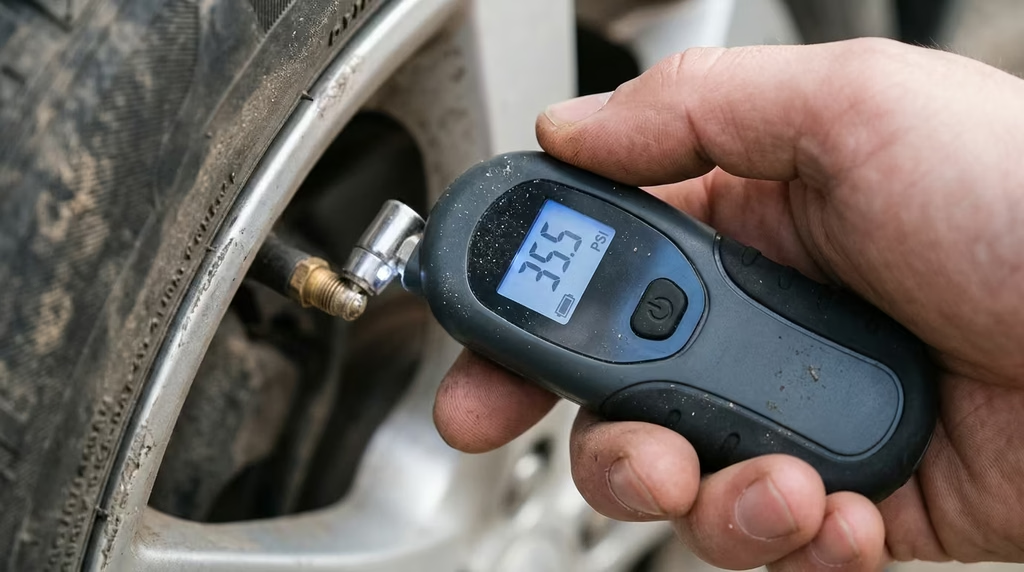
3. Longacre 53000 Series Digital Tire Pressure Gauge
Longacre is a legendary institution within the grassroots racing and motorcycle track community, renowned for stripping away frivolous novelty features in favor of pure, repeatable mechanical precision. The Longacre 53000 Series digital gauge features a specialized angled ball chuck manufactured from heat-treated solid brass, specifically angled to slip cleanly past oversized brake rotors and tight cast wheel spokes—a frequent frustration highlighted across riders on Reddit’s r/motorcycles.
Equipped with an ultra-responsive digital sensor measuring up to 100 PSI with 0.2 PSI resolution, the gauge delivers zero latency between valve contact and static pressure stabilization. Its auto-zeroing circuit automatically recalibrates upon startup to compensate for ambient barometric shifts, while the double-braided line shields the internal pneumatic passageway from kink-induced pressure ripples. While the display lacks festive multicolored LEDs, its high-contrast industrial monochrome LCD remains completely legible under direct high-noon summer sunlight.
- Optimized brass angle chuck easily navigates tight motorcycle brake calipers.
- Internal ambient barometric compensation prevents false readings in mountainous regions.
- Ultra-durable casing engineered for trackside paddock environments.
- Premium price point compared to entry-level consumer gauges.
- Screen does not feature an active backlight for nighttime emergency roadside use.
Key Engineering Factors When Choosing Digital Tire Pressure Gauges
When selecting professional pneumatic testing equipment, understanding the interplay between materials science and electronic sensor architecture ensures you invest in a tool that remains accurate over hundreds of temperature cycles. If you frequently pack specialized roadside emergency kits, combining a reliable digital gauge with high-capacity backup equipment like portable AC power banks for camping and emergency gear ensures you never get stranded off-grid.
1. Chuck Metallurgy: Why Solid Brass Trumps Zinc and Plastic
The chuck is the critical physical interface between your gauge and the valve core. Budget digital gauges frequently utilize chrome-plated die-cast zinc alloys or polycarbonate plastic housings. Zinc is brittle, susceptible to thread stripping when cross-threaded onto harsh steel or nickel Schrader stems, and prone to micro-porosity that causes slow air bleed during seating. Solid brass, by comparison, provides self-lubricating characteristics, unmatched impact resistance when dropped onto concrete, and corrosion resistance against road salts and brine.
2. Angle Chucks vs. Straight Chucks for Motorcycles
Motorcycle wheels present unique geometric hurdles compared to open automobile wheels. Massive front dual disc rotors and narrow hub clearance make straight push-on chucks virtually impossible to seat squarely without bending the rubber or metal valve stem. Choosing a digital gauge equipped with a 45-degree or 90-degree angled brass chuck on a 360-degree swivel allows you to align the chuck flush with the stem seal in tight clearances, eliminating spurious pressure drops.
3. Sensor Accuracy Standards: Full Scale (FS) vs. Resolution
Marketing packaging often conflates resolution (the ability of a screen to show numbers down to 0.1 PSI) with accuracy (the physical capability of the transducer to register the true pressure). Look for models adhering to ASME B40.7 Grade 2A or Grade A specifications. Grade 2A dictates that across the middle working range of the gauge, the reading is accurate to within ±0.50% of full-scale value. A gauge with a 100 PSI range will therefore stay within ±0.5 PSI of truth, whereas a 250 PSI gauge rated at ±1% could exhibit variance up to ±2.5 PSI.
Frequently Asked Questions
Why are brass chucks superior to steel or plastic chucks on tire gauges?
Solid brass is softer than steel valve threads but significantly harder than plastic, creating an airtight mechanical seal without gouging or stripping the external threads of the Schrader valve. Furthermore, brass is intrinsically non-sparking and impervious to atmospheric moisture, which prevents oxidation and binding inside the chuck spring mechanism over years of use in humid or wet garage environments.
Are digital tire pressure gauges more accurate than analog dial gauges?
Quality digital gauges are fundamentally more precise than mechanical Bourdon tube analog dial gauges because they rely on micro-machined piezoresistive silicon transducers. These solid-state sensors lack internal gear trains, delicate hairsprings, or mechanical pivots that can jump teeth or lose tension when dropped on shop floors. Additionally, digital screens eliminate optical parallax error when viewing the gauge needle from off-angles.
How often do digital tire pressure gauges need battery replacement?
Under typical monthly household usage, standard AAA or CR2032 lithium coin cells in a quality digital gauge last between 2 and 3 years. Premium units incorporate automatic 60-to-90-second sleep timers to prevent battery drain if left forgotten in a glovebox or tool cabinet. It is recommended to check battery contacts annually to prevent corrosion in vehicles subjected to freezing winter temperatures.
Can I use a 100 PSI digital tire gauge on both my motorcycle and SUV?
Yes. The standard operating cold tire pressure for both passenger cars and full-size SUVs ranges between 32 and 42 PSI, while modern road and adventure motorcycles typically run between 28 and 42 PSI. A 100 PSI gauge operates comfortably within its ideal mid-scale transducer window for both vehicles, providing maximum accuracy and resolution.