Disclosure: As an Amazon Associate, Varnilo earns from qualifying purchases at no extra cost to you. Our guides are built on deep manufacturer specification analysis, collector forum consensus, and verified owner reports.

Whether you are setting up a remote workstation deep in the woods or packing for an off-grid weekend road trip, modern device power demands quickly outpace standard pocket battery packs. While USB-C Power Delivery has simplified charging for lightweight ultrabooks, specialized hardware—including professional audio gear, drone battery docks, medical equipment, and older high-draw laptops—still demands a standard three-prong wall plug. Choosing a reliable portable AC power bank bridges the gap between pocket-sized travel batteries and bulky 30-pound power stations.
Unlike stationary high-output desk setups like a dedicated multi-port GaN charging station, mobile battery packs with built-in internal inverters must balance thermal dissipation, inverter conversion efficiency, and FAA flight restrictions within an ultra-compact chassis. In this breakdown, we skip marketing hype and examine real-world watt-hour efficiency, pure sine wave versus modified sine wave output, and verified hardware longevity across enthusiast community discussions.
Omnicharge Omni 20+ (71Wh / 20,000mAh)
Engineered for nomadic professionals, the Omni 20+ features an onboard 100W pure sine wave AC outlet, precision OLED parameter readouts, pass-through charging, and adjustable DC barrel output. Owners across hardware communities highlight its reliable thermal sensors, airline-safe 71Wh footprint, and uncompromised electrical output stability under heavy loads.
| Model | Key Specs & Materials | Community Verdict | Amazon Listing |
|---|---|---|---|
| Omnicharge Omni 20+ | 71Wh (20,000mAh), 100W Pure Sine Wave AC, 60W USB-C PD, OLED Screen, Polycarbonate frame (1.35 lbs) | Gold standard for field audio engineers and traveling videographers needing clean, surge-protected current. | Check Price → |
| Anker PowerHouse 90 | 87.6Wh (24,000mAh), 100W AC Outlet, 45W USB-C PD, Integrated LED Flashlight, Rugged ABS (1.87 lbs) | Highly praised for tent camping and emergency preparedness due to heavy-duty corner bumpers and light beam. | Check Price → |
| Powkey 146Wh Portable Bank | 146Wh (42,000mAh), Dual 200W Modified Sine AC Outlets, 4x USB-A, DC 12V Output, Impact Shell (3.3 lbs) | High-capacity budget powerhouse for overland basecamps, CPAP travel, and non-sensitive AC tools. | Check Price → |
Detailed Analysis of Top AC Power Units
1. Omnicharge Omni 20+ (100W Pure Sine Wave)
The Omnicharge Omni 20+ has earned a dedicated following on technical subreddits and digital production forums like r/BuyItForLife thanks to its uncompromising engineering. Unlike most compact power bricks that rely on cheap modified sine wave inverters, the Omni 20+ houses an advanced internal microcontroller paired with a genuine pure sine wave inverter capable of delivering up to 100W continuous output (120V AC, 60Hz).
Measuring 5.0 x 4.8 x 1.1 inches and weighing 1.35 pounds, this unit complies cleanly with FAA guidelines (rated at 71Wh, safely below the 100Wh carry-on ceiling). Its integrated OLED screen displays real-time battery cell health, internal temperature warnings, input/output wattage, and remaining runtime down to the exact minute. The programmable 100W DC barrel port also enables users to run high-draw equipment without inverter conversion loss.
- True pure sine wave output protects sensitive audio equipment and medical monitors
- Sub-100Wh capacity allows unrestricted commercial flight boarding
- Comprehensive OLED screen provides precise temperature and live wattage readouts
- Inverter fan can be audible in whisper-quiet recording environments
- Premium price point compared to standard non-inverter power banks
2. Anker PowerHouse 90 (87.6Wh Outdoor Specialist)
Designed primarily for weekend tent campers and disaster resilience kits, the Anker PowerHouse 90 balances portability with structural durability. Utilizing high-density lithium-ion cells encased in an impact-dampened ABS shell with silicone port covers, it packs 87.6Wh (24,000mAh) of nominal capacity into a 7.9 x 4.1 x 1.2-inch profile.
The single grounded AC wall outlet provides 100W output, easily handling 65W to 96W laptop charging bricks, camera battery cradles, or portable camp lighting. Alongside the AC socket, Anker integrates a 45W bidirectional USB-C Power Delivery port, two USB-A fast-charging ports, and a multi-mode warm LED flashlight with an SOS beacon mode. Verified owners consistently praise its passive and active cooling profile, which manages heat buildup effectively during multi-hour campsite usage.
- Ruggedized perimeter protection designed to survive dirt and rough table surfaces
- 45W USB-C input enables fast pack replenishment in under 2.5 hours
- FAA airline certified at 87.6Wh with generous reserve headroom
- LED indicator uses simple 8-dot step lights rather than an exact percentage screen
- Total combined simultaneous output cannot exceed 160W across all ports
3. Powkey 146Wh Portable Power Bank (Extended Basecamp Run)
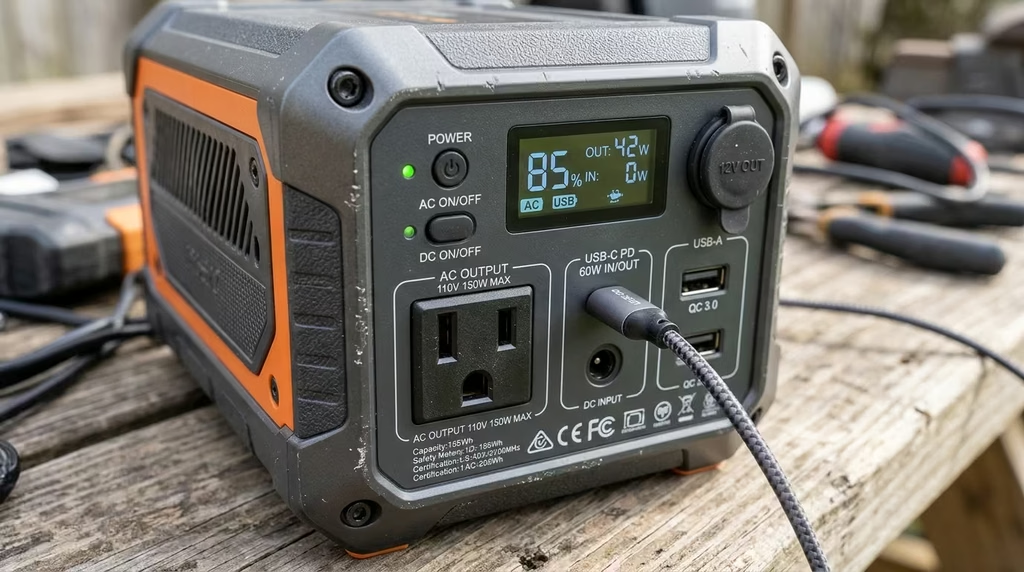
For campers and field technicians who travel by car and need raw capacity without stepping up to a full 10-pound generator, the Powkey 146Wh (42,000mAh) unit provides exceptional sustained output. Housing dual standard AC ports with a combined continuous ceiling of 200W (with 220W surge tolerance), it effortlessly supports larger peripherals, soldering irons, star-tracking mounts, or portable car refrigerators.
The battery management system (BMS) integrates multi-stage surge, short-circuit, and thermal protections with dual high-velocity exhaust vents. Keep in mind that at 146Wh, this device exceeds the FAA’s standard 100Wh carry-on allowance and is strictly restricted to ground transit. For van conversions, car tailgating, or remote cabin retreats, community members consistently rate it as one of the most reliable high-capacity values per dollar.
- Dual three-prong AC outlets provide 200W continuous output for multi-device powering
- Substantial 146Wh capacity yields multiple full laptop recharges
- Dual DC 12V barrel ports offer direct DC efficiency for camping accessories
- Exceeds FAA 100Wh limit, prohibiting commercial airline carry-on travel
- Modified sine wave output can generate slight electrical hum on low-end inductive fans
Portable AC Power Bank Engineering: What You Need to Know
Operating an AC wall socket from a pocketable DC lithium pack is an engineering challenge. When evaluating power solutions for demanding field work, consider these essential technical factors:
1. Pure Sine Wave vs. Modified Sine Wave
Direct current (DC) from lithium cells must be transformed into alternating current (AC) by an internal inverter circuit. Budget units often utilize modified sine wave (square wave) inverters. While adequate for incandescent lights and standard power adapters, modified waves produce electrical noise, excess heat, and potential firmware instability in delicate audio preamps, CPAP machines, and high-frequency studio equipment. Pure sine wave inverters replicate domestic grid power cleanly, guaranteeing zero hum and preventing long-term stress on switching power supplies.
2. The Inverter Tax: Real-World Efficiency Math
Never calculate runtimes based on gross advertised milliamp-hours (mAh). Inverter circuits incur an unavoidable energy penalty called conversion loss. When converting 3.7V DC to 120V AC, inverters typically operate between 75% to 85% thermal efficiency. Furthermore, running a low 10W load on a 100W inverter causes higher idle parasitic draw. If your device supports native USB-C Power Delivery—such as travel devices and like retro handheld gaming consoles—charge directly through USB-C ports to avoid inverter conversion penalties and maximize battery longevity.
3. Airline Transport Regulations (FAA 100Wh Rule)
Global aviation authorities (FAA, EASA, and TSA) place strict capacity limits on lithium battery carry-on luggage. Power banks under 100Wh (watt-hours) require no airline approval and can travel in cabin luggage freely. Batteries between 101Wh and 160Wh require prior airline operator sign-off and are restricted to two units per passenger. Anything above 160Wh is banned from commercial flights entirely. If domestic or international air travel is in your routine, prioritize units rated between 70Wh and 99Wh.
Frequently Asked Questions
Can I plug an electric kettle, coffee maker, or hair dryer into these banks?
No. High-thermal household appliances like coffee brewers, hair dryers, and microwaves typically draw between 1,200W and 1,800W. Compact portable AC power banks provide continuous limits between 80W and 200W. Plugging in high-wattage heating appliances will immediately trip the bank’s internal over-current circuit protection.
Why does the internal fan turn on even with small loads?
Inverter circuits generate considerable concentrated heat while boosting low battery voltages up to 110V/120V AC. Active cooling fans are programmed to trigger at set thermal thresholds to preserve lithium cell lifespan and prevent dangerous overheating inside tightly sealed enclosures.
How do I calculate how many times an AC power bank will charge my laptop?
Multiply the power bank’s Watt-hour (Wh) rating by 0.80 (accounting for roughly 20% inverter and thermal conversion loss). Then divide that adjusted figure by your laptop battery’s internal Watt-hour capacity. For example, a 60Wh laptop running off an 87.6Wh bank will receive approximately 1.15 full charges.
Can I use the AC outlet while recharging the power bank?
This depends on whether the unit supports true pass-through power distribution. Premium models like the Omnicharge Omni 20+ feature dual-circuit architecture that safely handles simultaneous input and output without degrading internal chemistry. Cheaper units often disable AC ports automatically when plugged into a wall charger.