Disclosure: As an Amazon Associate, Varnilo earns from qualifying purchases at no extra cost to you. Our guides are built on deep manufacturer specification analysis, collector forum consensus, and verified owner reports.

Braving sub-freezing temperatures on daily transit platforms, bleachers, or mountain trails exposes the glaring weaknesses of single-use chemical air-activated pouches. Disposable warmers rarely produce sustained thermal output in bitter winds, create recurring landfill waste, and offer zero control over temperature spikes. Investing in top-tier rechargeable hand warmers solves these headaches by delivering instant, surface-calibrated warmth at the press of a button, alongside dual-purpose power bank capabilities for depleted smartphones in cold weather. Similar to how cold temperatures drain cells in larger portable power banks for cold weather camping, sub-zero conditions punish low-grade lithium packs, making internal component selection paramount.
To determine the most dependable devices for winter commuters, hikers, and stadium sports attendees, we dissected manufacturer component sheets, teardown schematics, and long-term user feedback across dedicated outdoor gear forums. This technical evaluation highlights battery cycle longevity, surface thermal distribution, chassis ergonomics, and safety circuitry across today’s top-rated models.
OCOOPA Union 5s Modular Hand Warmer
The OCOOPA Union 5s leads community recommendations due to its innovative swappable battery core design, aerospace-grade brushed aluminum shell, and 10,000mAh high-density pack. It delivers true 360-degree dual-sided heating reaching up to 145°F (63°C) with continuous temperature regulation managed by onboard NTC thermal sensors.
| Model | Key Specs & Materials | Community Verdict | Amazon Listing |
|---|---|---|---|
| OCOOPA Union 5s | 10,000mAh Detachable Core, Aircraft Aluminum, 4 Temp Settings (95°F–145°F), USB-C PD | Voted top overall for modular endurance, swappable cores, and comfortable curved palm grip. | Check Price → |
| Zippo HeatBank 9s | 5,200mAh Lithium-Ion, Ruggedized Polycarbonate/Alloy, 6 Heat Levels (up to 120°F) | Legendary outdoor brand reputation; rugged drop resistance ideal for ski lifts and trail work. | Check Price → |
| HauStone Dual Magnetic | 2x 5,000mAh (10,000mAh Total), Snap-Together Neodymium Magnets, Dual Pocket Setup | Best split-unit design for commuters who want simultaneous warmth in both coat pockets. | Check Price → |
Detailed Technical Breakdown of the Top 3 Models
1. OCOOPA Union 5s Modular Hand Warmer
The OCOOPA Union 5s redefines consumer expectations by directly resolving the main point of failure in electronic warmers: battery cell cycle decay. Most budget units force buyers to discard the entire heating shell once the internal lithium pouch loses retention. OCOOPA engineers built the Union 5s with an interchangeable internal battery cartridge, allowing users to swap in an extra charged core during extended sub-zero excursions or replace an aged cell years down the line. Verified contributors in the Reddit r/BuyItForLife community consistently highlight this modularity as a substantial reliability upgrade over sealed plastic alternatives.
Under the aircraft-grade aluminum alloy outer casing sits a sophisticated ceramic heating element managed by dual Negative Temperature Coefficient (NTC) sensors. This architecture prevents localized hotspots, ensuring that heat spreads evenly across the entire surface rather than concentrated at a single uncomfortable contact point. Offering 4 calibrated thermal settings ranging from a gentle 95°F up to a blisteringly fast 145°F, it achieves peak warmth in under four seconds from a cold boot.
- Modular swappable 10,000mAh battery core dramatically extends practical hardware lifespan.
- Dual NTC sensors offer precise thermal runaway protection across all 4 heat profiles.
- Fast-charging USB-C bidirectional port functions as an emergency 18W power bank.
- Slightly heavier chassis (approx. 240g) compared to smaller single-season warmers.
- Maximum temperature setting (145°F) drains the 10,000mAh cell in roughly 4 to 5 hours.
2. Zippo HeatBank 9s
Known primarily for its refillable catalytic fluid warmers, Zippo took its outdoor thermal heritage and packed it into a clean, impact-resistant electronic package with the HeatBank 9s. Encased in an ergonomic matte alloy shell that fits naturally into gloved palms or deep ski jacket pockets, the 9s utilizes dual-sided heating plates engineered to maintain consistent surface contact. With six distinct heat levels topping out at a comfortable 120°F, it prioritizes endurance and gentle maintenance warmth over aggressive scorching heat.
The unit incorporates an intuitive LED numerical and icon status display, giving commuters and hunters real-time battery fuel readings without guesswork. While its 5,200mAh battery capacity is smaller than OCOOPA’s flagship, Zippo’s conservative thermal throttling delivers up to 9 hours of continuous low-setting warmth, making it particularly dependable during extended ice-fishing outings or morning high-school football games.
- Ergonomic narrow profile fits comfortably inside slim glove liners and jacket sleeves.
- Six granular heat steps prevent excessive hand sweating inside insulated gloves.
- Ruggedized impact-resistant frame withstands accidental drops onto concrete platforms.
- Recharges via older micro-USB standard rather than modern USB-C.
- Peak temperature maxes out at 120°F, which may feel underwhelming in below-zero blizzards.
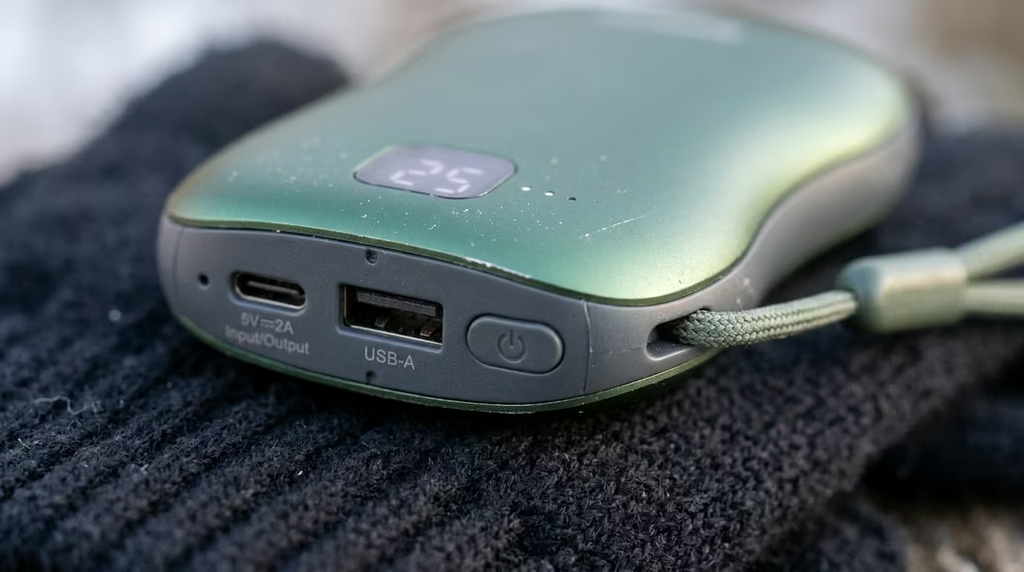
3. HauStone Dual Magnetic Split Hand Warmers
For daily city commuters walking between subway lines and bus shelters, warming only one hand while shuffling a single device between pockets is frustrating. HauStone solves this usability issue using dual matched warming pods integrated with high-strength internal neodymium magnets. When joined together, they form a single oval warming unit that slips easily into a coat pocket or backpack sleeve. When snapped apart, you have two fully independent warmers—one for each hand—delivering synchronized 360-degree heat.
Each pod carries its own independent 5,000mAh battery cell, granting a cumulative 10,000mAh capacity. They feature three selectable heat steps reaching up to 131°F and charge simultaneously via an included split Y-cable. Owner feedback on commuter forums notes that the rubberized perimeter trim provides secure traction even when handled with damp, fleece-lined gloves.
- Magnetic snap coupling allows seamless transition between single-hand or dual-pocket use.
- Split architecture provides genuine warmth to both hands without buying separate chargers.
- Ultra-compact teardrop contour minimizes bulk inside slim office slacks and overcoat pockets.
- Magnets can inadvertently attract loose keys or paperclips inside unzipped bag compartments.
- Charging both depleted pods simultaneously demands a capable 15W+ USB-C wall adapter.
Key Engineering Factors When Choosing Rechargeable Hand Warmers
Selecting the best warming companion requires examining component specifications rather than marketing claims. Cold environments place unique stresses on electronics that typical consumer gadgets never face.
Lithium-Ion Chemistry in Sub-Zero Climates
Lithium-ion batteries suffer reduced electrolyte conductivity and increased internal resistance as temperatures drop toward 32°F (0°C) and below. Cheap battery cells quickly drop voltage under high current draw, causing unbranded hand warmers to abruptly shut off after only 30 minutes in cold winds. Reputable manufacturers integrate internal resistive thermal feedback loops that direct a portion of initial heat inward toward the cell compartment, insulating the battery from rapid temperature-induced voltage collapse. Keeping your gear topped off on modern charging stations, like dedicated desk surge protectors with USB-C PD, ensures healthy charging curves between daily winter commutes.
Safety Protocols and Thermal Regulation (NTC Sensors)
Because these devices generate deliberate surface heat while encased in your pocket, thermal regulation is non-negotiable. Look for warmers certified under UL, CE, or FCC standards that clearly advertise Negative Temperature Coefficient (NTC) chips. An NTC sensor continuously measures surface temperatures thousands of times per second. If the unit is trapped in a non-breathable down jacket pocket where trapped heat could dangerously escalate, the internal controller automatically steps down current to prevent thermal runaway or skin burns.
Chassis Materials: Anodized Aluminum vs. Molded ABS
The chassis material dramatically impacts how heat transfers to your skin. Brushed or anodized aerospace aluminum offers high thermal conductivity, transferring heat from internal PTC elements to your skin almost instantaneously. However, in extreme negative temperatures, bare metal can feel uncomfortably icy for the first three seconds of contact. Composite ABS plastic edges provide a more comfortable initial touch, but slow down thermal transfer. The ideal commuter design features an aluminum contact face framed by textured silicone or impact-dampening ABS borders.
Frequently Asked Questions
Are rechargeable hand warmers permitted on commercial airline flights?
Yes, but with critical Federal Aviation Administration (FAA) and TSA restrictions. Because electronic hand warmers house lithium-ion or lithium-polymer battery packs, they must be kept in your carry-on baggage. They are strictly prohibited inside checked luggage due to lithium fire safety protocols. Additionally, they must remain turned off during takeoff and landing.
Can I use an electronic hand warmer to recharge my smartphone?
Most modern warmers with capacities of 5,000mAh or higher include an integrated 5V/2A or 9V/2A USB output port that operates as a backup power bank. While using the power bank feature simultaneously with active heating will cut your thermal runtime substantially, it provides valuable emergency backup power during freezing commutes when phone batteries typically drain fast.
How hot should an electronic hand warmer get to prevent skin burns?
Prolonged contact with surface temperatures exceeding 125°F (52°C) can cause superficial low-temperature burns if left against bare skin without movement. Premium models reach up to 135°F–145°F specifically for use inside insulated winter gloves or through fabric pockets. When holding a warmer bare-handed, stick to the lowest heat setting (typically 95°F–110°F) or utilize the protective microfiber storage pouch commonly bundled with the unit.
How many winter seasons will a quality rechargeable hand warmer last?
Standard consumer lithium-ion cells maintain approximately 80% of their rated capacity through 300 to 500 complete discharge and recharge cycles. For a daily commuter using the device five days a week across four cold winter months (roughly 70 cycles per season), a quality warmer from brands like OCOOPA or Zippo will reliably deliver three to five seasons of active service before showing noticeable runtime drop-offs.